
Commentary
Political Pathways to a Just Transition: Why country platforms must start with political economy
Country:
Global,
Organisation:
ODI Global,

Few ideas have gained as much traction in international climate policy as that of the just transition. Governments and development partners are increasingly recognising that the shift to cleaner energy will succeed only if it is socially and politically sustainable.
Increasingly, they are trying to deliver this through country platforms: arrangements that align national transition plans with coordinated international finance, investment, and technical support. Just Energy Transition Partnerships (JETPs), are the best-known examples. The idea is attractive, but progress has been uneven.
One reason is that country platforms can treat transition principally as a problem of finance, technology, and planning. Yet energy transitions are also political transformations: they redistribute rents, jobs, and investment; they alter who pays for energy; and they shift power among governments, firms, workers, communities, and consumers. They create winners and losers—and some losers have both reason and power to resist.
This is why country platforms need political-economy analysis: evaluations of how power, interests, and institutions shape what governments are willing and able to do. Two concepts are especially useful: the energy bargain and the political settlement.
Every transition disrupts an energy bargain
Energy systems are not just technical systems; they are also political bargains. Governments distribute benefits through affordable fuel and electricity; jobs; contracts; regional investment; industrial policy; and, sometimes, fossil fuel rents. These arrangements create firms, workers, communities, consumers, and elites with a stake in the status quo.
Transition disrupts these bargains. In some countries, the main challenge is the influence of fossil fuel firms and rent-backed coalitions. Elsewhere, governments must protect coal communities, compensate workers, maintain affordable energy, or create alternative regional jobs. Often, several challenges coexist.
The energy bargain therefore tells policy-makers and international partners what the justice problem is: who stands to lose; which interests matter politically; and what forms of participation, protection, or compensation may be needed. But identifying the challenge is only half the task. Country platforms must also ask whether the political settlement gives governments the incentives and capability to respond.
Political settlements shape what justice is possible
A political settlement is the underlying distribution of power on which government rests. Two features matter particularly for a just transition: how broadly the ruling bargain incorporates social groups; and how concentrated or dispersed the authority to coordinate and implement policy is.
These features bear on two dimensions of justice. Procedural justice concerns whether affected groups can influence decisions. Distributive justice concerns whether governments can protect those who lose through compensation, retraining, regional investment, affordable energy, social protection, or new economic opportunities.
In general, political settlements with broad social foundations give governments stronger incentives to recognise affected groups, creating more potential for procedural justice. On the other hand, political settlements with concentrated and disciplined authority can make coordination, compensation, and investment easier, creating more potential for distributive justice. Neither relationship is automatic: broad settlements can still marginalise particular voices, while concentrated power may be ineffective, exclusionary, or committed to fossil fuel development. But together, the two dimensions suggest four stylised pathways.
Four political pathways
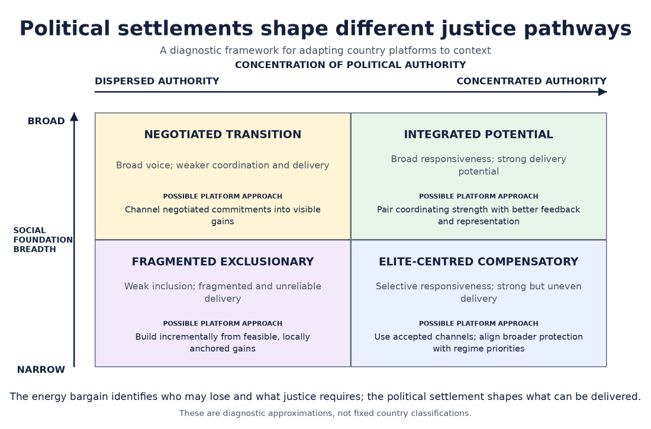
The pathways created by the two types of political settlement are shown in Figure 1.
Figure 1. Political pathways and priorities for country platforms (Source: Author).
Negotiated transition
Broad social foundations combined with dispersed authority give affected groups considerable voice but make implementation difficult. South Africa broadly approximates this pattern. Its transition has been extensively negotiated among unions, coal communities, business, municipalities, and civil society, but converting commitments into electricity infrastructure, regional diversification, and visible support remains challenging.
Country platforms in such contexts can try to channel voice into deliverable gains, so as to strengthen implementation without crowding out participation. For example, they can do this by aligning responsible institutions, by financing implementable, regional projects, and by sequencing early wins that sustain a coalition for wider reform.
Integrated potential for just transition
Broad social foundations combined with concentrated authority offer the strongest inherent potential to combine broad responsiveness with coordinated delivery. Governments possess the capacity to act, while their dependence on—or need to maintain legitimacy among—relatively wide sections of society gives them incentives to provide broadly valued benefits.
Thailand is an imperfect but instructive approximation: governing coalitions face pressure from substantial electoral, provincial, business, agricultural, and industrial constituencies, while decisive power is concentrated in a royalist–military–judicial establishment. Its energy bargain rests less on fossil export rents than on affordable energy and industrial competitiveness.
But a broad social foundation does not necessarily entail open or well-institutionalised participation. Governments may permit voice only through tightly controlled channels; weak feedback can produce poorly informed policy; and groups lying outside the ruling bargain may still be neglected. Country platforms can help by creating context-appropriate channels of communication between decision-makers and affected communities, and by giving representation to groups otherwise marginal to the settlement. This can improve policy feedback and widen the distribution of transition benefits without assuming forms of participation that the prevailing political context cannot sustain.
Elite-centred compensatory transition
Where authority is concentrated but the ruling coalition is narrow, governments may possess considerable capacity to coordinate and deliver, but have weaker incentives to recognise groups outside the ruling bargain. Vietnam illustrates this pathway. Its party-state can coordinate infrastructure and industrial policy better than most, but an energy bargain entangled with coal, state-owned enterprises, and growth gives priority to strategically important sectors.
For country platforms, the challenge is to make protection for affected populations intelligible in terms of objectives the ruling coalition already values. In tightly institutionalised party-states, this may mean channelling workers’ and communities’ interests through accepted structures such as labour ministries, official unions, or party organisations. Elsewhere, platforms may be able to construct positive-sum bargains that link social protection, reskilling, or improved working conditions to productivity, export access, industrial upgrading, and political stability.
The aim of these positive-sum bargains is not to assume that elites will become intrinsically more inclusive, but to demonstrate how a more just transition can reinforce economic performance and the longer-term interests of the ruling coalition.
Fragmented exclusionary transition
Narrow social foundations combined with dispersed authority offer neither broad participation nor reliable compensation. Guatemala provides an illustration: elected authority is constrained by entrenched institutional, economic and political networks, while transition conflicts centre on affordability, territorial control, Indigenous rights, and the distribution of renewable-energy benefits. These are inherently difficult environments for country platforms, and comprehensive programmes premised on coherent state action are unlikely to succeed.
A more promising approach may be to work incrementally, looking for politically feasible entry points around particular projects, institutions, or affected groups. Depending on the context, this might involve strengthening a specific delivery mechanism, supporting credible local coalitions, protecting vulnerable communities, or creating small islands of accountability. Such interventions will not transform the wider political settlement in the short term. But visible gains can build trust, relationships, and organisational capacity, creating precedents and constituencies from which more ambitious and inclusive action may gradually become possible.
What does this mean for country platforms?
The point is not that country platforms should attempt to transform political settlements. That is neither realistic nor within their mandate. Nor should political realism become an excuse for accepting injustice. The aim is to distinguish long-term objectives from feasible short-term advances and to identify where external support can expand justice at the margins.
Platforms should therefore begin with two diagnoses. The energy bargain identifies the interests and dependencies that a transition will disrupt: fossil rents, jobs, affordable energy, industrial competitiveness, regional livelihoods, or access to land and infrastructure. The political settlement identifies whose claims matter, where veto power lies, and whether government can coordinate and deliver.
They should then calibrate ambition, partners, and sequencing to those realities. In some settings the priority will be stronger implementation; in others, it will be a wider voice, more inclusive compensation, or tightly targeted protections around particular projects. Strategies that assume participation, coordination, or universal compensation that the settlement cannot support risk remaining aspirational documents with little practical effect.
The purpose of political-economy analysis is not to constrain ambition; it is to make ambition politically intelligent. By grounding country platforms in realistic assessments of both energy bargains and political settlements, policy-makers have a better chance of designing transitions that are not only cleaner, but also more just—and more likely to endure.
Tim Kelsall is a Senior Research Fellow in the Climate and Environment Team at ODI Global. Previously he taught at Oxford and Newcastle Universities and worked as a freelance consultant. He has published extensively on political economy and political settlements, teaches on The Policy Practice and ODI’s ‘Political Economy in Action’ course, and currently focuses on energy transitions and African cities.
Related Posts


Stay Informed and Engaged
Subscribe to the Just Energy Transition in Coal Regions Knowledge Hub Newsletter
Receive updates on just energy transition news, insights, knowledge, and events directly in your inbox.