
Interview
"This is your land": How Yayasan Mitra Hijau is engaging coal communities in East Kalimantan and South Sumatra
Istu Septania in conversation with Dicky Edwin Hindarto, Chair of the Governing Board and the Innovation Regions for a Just Energy Transition (IKI JET) Project Coordinator at Yayasan Mitra Hijau
Country:
Indonesia,
Organisation:
Yayasan Mitra Hijau,
Indonesia is pursuing a just energy transition and economic transformation in its coal-dependent regions. Local civil society organisation Yayasan Mitra Hijau (YMH), which is part of the Climate Action Network, has been working closely with many different groups in coal communities across South Sumatra and East Kalimantan, offering support through dialogue and capacity building. In this interview, Dicky Edwin Hindarto, the chair of the governing board and the Innovation Regions for a Just Energy Transition (IKI JET) project coordinator at YMH, shares his experiences on the ground.
What activities does YMH carry out with coal communities?
YMH follows the non-tripartite model, which means we work with groups that are not governments, not coal miners, and not capital owners. So, we work with eight stakeholder groups: women; young people; communities living near coal mines; non-governmental organisations (NGOs); journalists; local government except for the Manpower Agency; academics; and the private sector.
When we began our work, nobody understood the concept of just energy transition—from young people to communities near mining locations, and especially women. Even those in local government didn’t know about it. It wasn’t until I invited them for a site visit to a solar installation in Samarinda that they saw it up close and learned how it worked.
Our approach is to go all out. While others use a silver bullet, we aim for widespread impact. We have many target groups, so we try to reach them all at once to make the most of our resources.
First, we mapped the eight stakeholder groups. There is some overlap, such as young journalists, or women who live near coal mines. We identified who these stakeholders are and where they live. Then we mapped their needs to understand what type of capacity building was required for each group. We also developed a communication strategy for approaching each of them. We conducted a series of focus group discussions to gather local insights and co-develop solutions and tailored workshops to strengthen their skills. Later, we evaluated the outcomes and measured the impacts to ensure continuous learning.
Our programmes include raising awareness and building capacity to train practitioners, business leaders, NGOs, and academics on just energy transition. In East Kalimantan, we conduct training sessions on solar power, biomass, green tourism, energy efficiency, and carbon markets. We do the same in South Sumatra, with an additional focus on sustainable coffee production. We also train women in entrepreneurship to boost family income.
Crucially, this engagement has become two-way. We are now invited to events held by the government, by local radio stations, and by universities. We’ve also been invited to present at international seminars, including events organised by other local governments.
How did you approach engaging with the media?
The media is the backbone of our outreach. We learned that our biggest opportunity was to activate the media outlets that had been silent on this issue thus far. In East Kalimantan and South Sumatra, the local media organisations mostly copied and pasted from the national outlets. So, I visited their offices and organised training sessions for the journalists on how to report on just energy transition topics. As a result, the coverage grew almost fourfold in just over 3 years.
The second layer is college media. Many professional reporters started out writing for their campus newspapers. So, we work with them too.
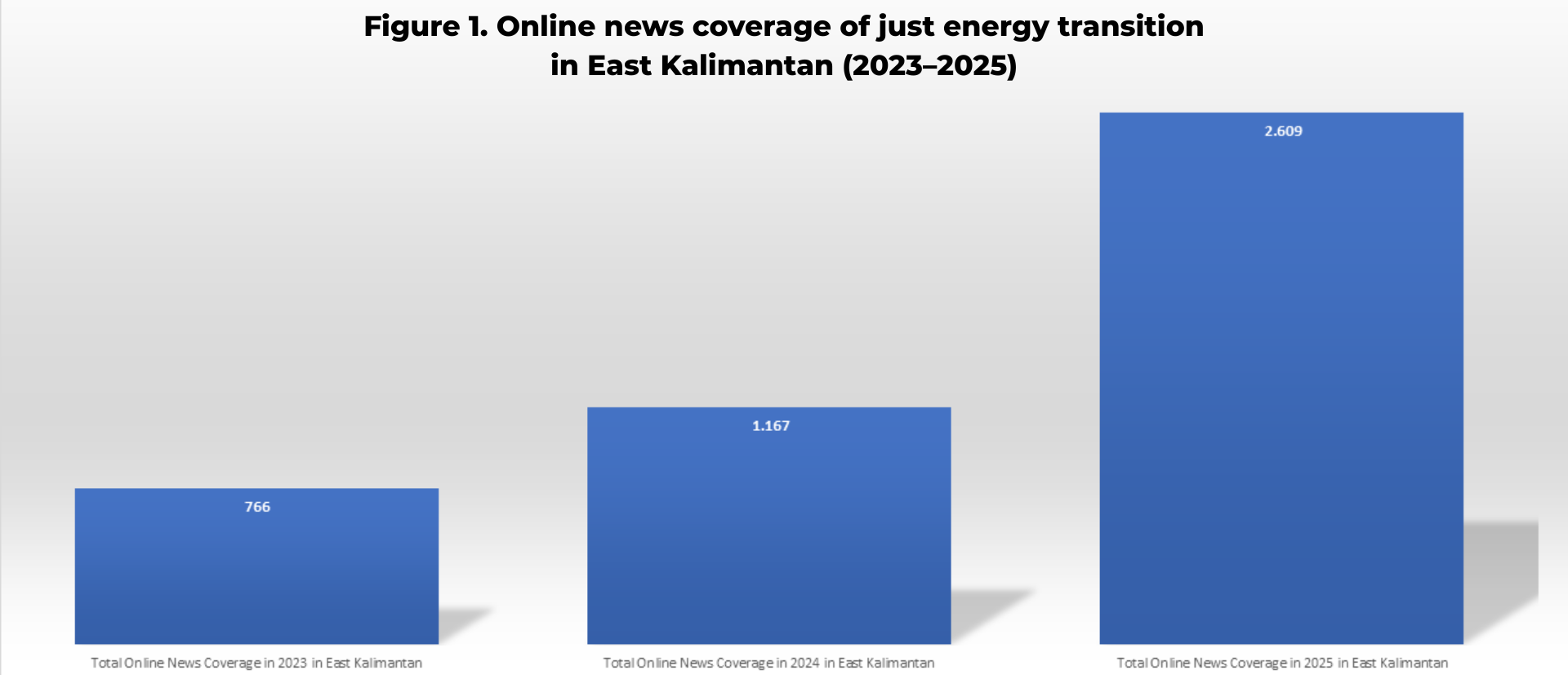
News coverage of just energy transition in East Kalimantan has nearly tripled between 2023 and 2025, from 766 to 2,609 articles. As YMH trained local reporters, outlets began inviting YMH back to speak. (Source: Yayasan Mitra Hijau media tracking data)
How did you engage with young people?
To engage with young people, the easiest approach is to partner with universities. In East Kalimantan, we have four partnership agreements with the following universities: the University of Mulawarman, the University of Muhammadiyah East Kalimantan, and the University of Nadhlatul Utama, and the Kalimantan Institute of Technology. In South Sumatra, we have two: one with the University of Muhammadiyah and the other with the University of Sriwijaya.
The partnership agreements give us a platform for reaching young adults and their lecturers. They are how we create guest lectures for students when they don’t have high academic loads. We use these approaches in both provinces, but we adapt them to the specific circumstances in each region.
We also have informal partnerships with other universities through intense discussions.
In January 2026, we had one joint event with the University of Balikpapan, in which we don’t have a formal MOU yet, and we also managed to invite Coordinating Economy Minister Airlangga Hartarto and East Kalimantan Governor Rudy Mas’ud to speak on energy transition. This is something no other civil society organisation has done before. It was the young people themselves who organised the event and extended the invitation.
From our engagement with young people, we’ve launched [a digital campaign called] Green Zetizen, which is another platform for digitally savvy young people in East Kalimantan who want to create social media content on climate and just transition topics. The young people run the campaign, but, of course, we also provide them with training. In less than a year, the account has gained over 200,000 views and not only built a local youth audience but also reached global followers.
View this post on Instagram
In 2024, YMH rolled out an Instagram Reel competition titled Youth Voices for Green Energy. The winner, Arif Al Hikmal, expressed the hope that the government will curb non-renewable power plants and focus on meeting its clean energy targets.
The key lesson is that most NGOs target young people, but many don’t adequately adapt their tone or language to appeal to this audience in their posts, and they don’t prepare a communication strategy. That should be there from the beginning. Who are the target audiences? How do we approach young people? What issues resonate with them? We don’t just chase trending topics; we engage with issues that directly affect young people and that they care about.
View this post on Instagram
Green Zetizen is a youth-led digital campaign on just energy transition, funded by the Innovation Regions for a Just Energy Transition (IKI JET) project. The team received regular training on sustainability news and trends and how to secure funding beyond the project period.
For the Green Zetizen campaign, we partnered with local newspaper Kaltim Today specifically because their editorial team is young. The editor-in-chief is around 30 years old, and of the staff hired for Green Zetizen, some are still in college and some have just graduated. The result is that both the reporters and the content reflect youth culture.
Through all these activities, we’re trying to raise awareness of just transition and green jobs among young people. Their aspirations are shifting: mining is no longer their only ambition.
Green Zetizen has launched a podcast series explaining the urgency, relevance, and opportunities of a just energy transition.
What was your approach with women in coal communities?
When we wanted to approach communities living near coal mines, we engaged with the mothers first. Only then would the fathers follow. The fathers are harder to reach because they work during the daytime.
So, we approached local women. First, we mapped their awareness of just transition, skills, and living environments. They generally weren’t aware of the idea of a just energy transition. Many of them run small businesses but struggle to divide business and household spending. They make products like jackfruit chips, but the packaging isn’t attractive, and there is no halal certification so they can’t enter online markets. They also face challenges like limited land on which to grow their own produce, so they end up buying jackfruits and bananas from other regions.
From there, we give them basic training which covers financial literacy, profit and loss, online marketing, packaging, and halal certification. We also teach them how to network, and we helped establish a women’s forum where members can connect and sell their products to each other. This forum, known as the East Kalimantan Women’s Forum, was created as part of the IKI JET project and exists separately from women’s groups like Aisyah, although many members of those groups have also joined our forum. The ideas they received from us became seeds that grew. They started green initiatives, such as organic crops and composting, and some are now writing funding proposals for projects like mangrove planting.
One opportunity we’re still working on is connecting communities directly with the Corporate Social Responsibility (CSR) Forum, whose members are from both coal and non-coal sectors. What we’re pushing for now is a shared platform where communities can submit proposals directly to the forum, without having to rely on consultants from Jakarta who are typically brought in to design CSR programmes there.
The village of Mulawarman has received training to spur its eco-edu tourism and women-led micro, small and medium-sized enterprises (MSMEs). Many of its MSME actors are also part of the Women’s Dialogue Forum, which focuses on capacity building in leadership, financial management, and access to green financing. YMH has held a series of focus group discussions and workshops to help local entrepreneurs develop green businesses, such as ecotourism. They use a “push-and-pull” approach: promoting just energy transition through media and campaigns, while drawing communities into dialogue and participation through focus groups and workshops.
A successful just transition also needs participation from the private sector. What does that process look like for YMH?
When we began our work, it was hard to engage with coal companies. We work with Indonesian Employers Association (APINDO), but the coal companies aren’t part of it. It turned out that the CSR Forum, especially in East Kalimantan, served that role well. We liaised with the forum for six months while they evaluated how this partnership would benefit the companies. We eventually signed a memorandum of understanding with the forum and have since conducted a series of activities with companies through their CSR departments.
YMH has given various training on the green economy for these companies, focusing on biomass, carbon markets, and energy management, among other topics. The community needs businesses like these in the fields of renewable energy and sustainability, but it’s the private sector that can make them happen and create the jobs that come with them. They spend hundreds of billions of rupiah on CSR programmes, creating opportunities to drive a just energy transition.
The concept of sustainability thinking has spread within the forum. For example, companies are now using their CSR funds to install solar panels on school buildings and organising waste circularity workshops.
Sometimes, forum members also volunteer as trainers for small businesses by providing courses on digital marketing and waste management.
Our Energy Story, a comic book developed by Yayasan Mitra Hijau, explores the complexities of the inevitable coal transition, showing the perceptions, struggles, and hopes of five characters from different walks of life.
Can you explain why you don’t follow the same approach in both provinces?
Even though both regions mine coal, each province has different social, economic, and psychological conditions. You can’t use the same playbook for both.
Communities in East Kalimantan experience mining more directly. They’re both victims and participants. Their fathers work in the mines, but they have to deal with floods and sinkholes caused by mining. They see hundreds of coal barges on the river each day, but they remain poor. They have stories to tell about the damage around their homes, or about fatalities. That’s what fires them up during discussions—they want to be agents of change.
South Sumatra is different. There are no coal mines in its capital, Palembang; they’re mostly in Lahat and Muara Enim, 7 hours’ drive away, and coal is mainly transported over land, mostly by train or truck, straight from the mines to the port. In Palembang, people see shopping centres.
They don’t see the impacts of coal mining and the urgency in the way that people in Samarinda [in East Kalimantan] do.
If an issue isn’t in your backyard, it’s not really an issue; it becomes a story. And if it’s just a story, it’s just coffee shop talk. It doesn’t affect your life.
But it’s different in coal towns like Muara Enim and Lahat. The stakeholders there, from civil society organisations to young people, are pushing for change. When we were looking for youth champions in South Sumatra, we found them in Muara Enim and Lahat. If you get hit, who goes to the police and pushes hardest? It’s the victims, not the witnesses.
For this reason, we also adopted a different approach in our engagement with the CSR Forum in South Sumatra.
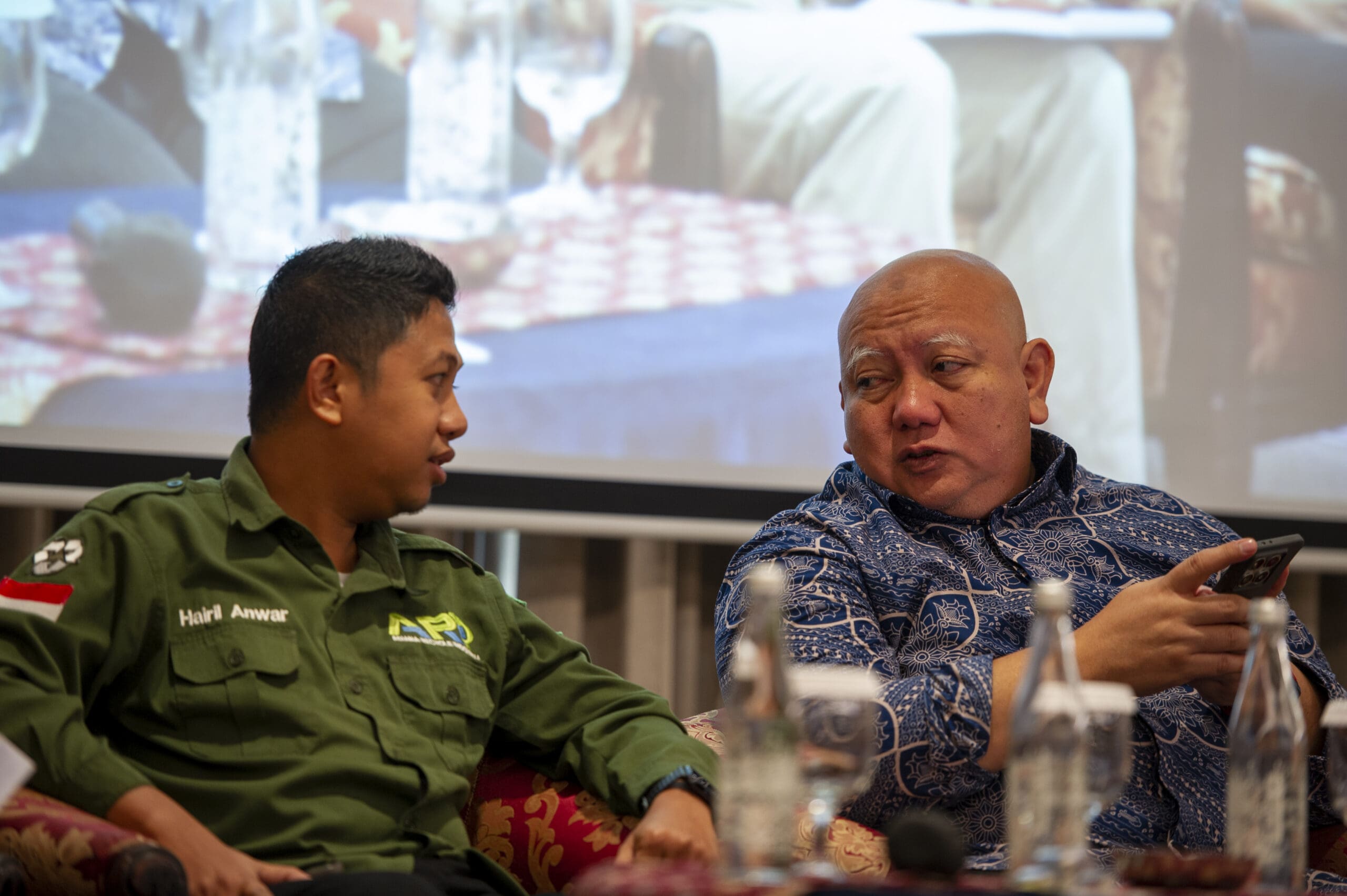
Dicky Edwin Hindarto (right) at the National Policy Dialogue on June 9, 2026, in Jakarta. Photo: © Yayasan Mitra Hijau
From your experiences of working in this field, how should we create more conducive conditions for a just transition in coal provinces?
The real problem is that every decision in the mining sector, including reclamation requirements, is centralised in Jakarta.
The Job Creation Omnibus Law (UU Cipta Kerja) enacted in 2020 has concentrated central authority. Meanwhile, Government Regulation (PP) No. 96/2021 on mineral and coal mining business procedures puts all oversight at the national level, with virtually no regional involvement. Local governments can’t do much beyond absorbing the impact. They can pass local regulations, but strategic decisions come from Jakarta.
CSR doesn’t require public transparency; companies only need to report to the Ministry of Energy and Mineral Resources. Even the Community Development and Empowerment Programme (PPM), that is legally mandated under the Mining Law, is barely known of at the regional level and rarely enforced.
Some programmes are ill-fitted to the wider environment. One village complained about monkeys raiding their crops. How did this happen? Because when the company reclaimed the land, they planted no fruit trees. Why? Because they had to follow a reclamation plan submitted to the ministry 20 years ago, and changing it would have required ministerial approval.
The broader point is that energy transition isn’t just about mine workers; it’s about economic diversification for entire communities. In East Kalimantan, mine workers number around 100,000 out of a population of 4 million. In South Sumatra, it’s roughly 50,000 out of nearly 9 million. Framing the transition as a mine worker issue misses the vast majority of people who are affected by it.
This isn’t just a question for provinces; it’s a question for the nation. Only 20% of Indonesia’s coal is used domestically for energy security, and 80% is exported. That means a coal transition doesn’t primarily come from domestic energy policy. It hinges on global demand, which is already declining, as reflected in the reduced mining quotas in the annual production plan. Global demand is also subject to geopolitical and energy security factors.
If coal regions rely on coal for everything, they’re vulnerable. They need to build new sources of employment and economic activity now.
“This is your land.” That’s what we keep telling young people, women, and local communities. “What happens next is up to you. Don’t wait for the next training or the next hotel dinner. The time to move is now.”
“The Last Coal” is a documentary by Yayasan Mitra Hijau capturing the lived experiences of communities in coal regions and the work being done by local initiatives towards a sustainable future in East Kalimantan.
Dicky Edwin Hindarto chairs the Governing Board of Yayasan Mitra Hijau (YMH) and serves as IKI-JET Project Coordinator for YMH, representing the Climate Action Network. He began his career as an energy auditor before moving into renewable energy development, Indonesian climate negotiations at the UNFCCC, and as an independent consultant for initiatives in carbon markets, energy, and sustainability.
Stay Informed and Engaged
Subscribe to the Just Energy Transition in Coal Regions Knowledge Hub Newsletter
Receive updates on just energy transition news, insights, knowledge, and events directly in your inbox.