
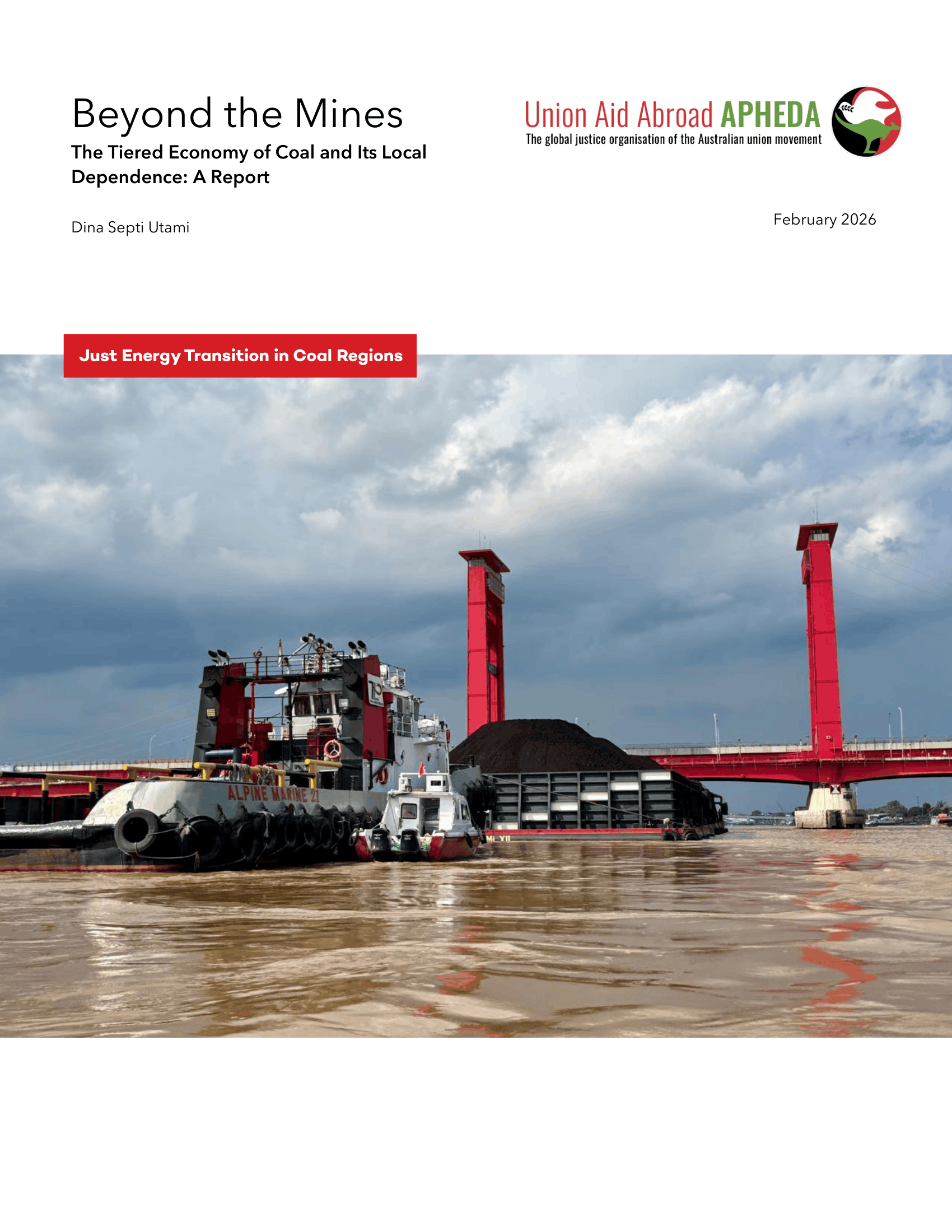
News post
Indonesian Trade Unions and Coal Mining Companies Reach Deals on Just Transition
Thanks to successful negotiations between trade unions and coal mining companies, collective bargaining agreements (CBAs) in East Kalimantan and South Sumatra now include explicit clauses on just transition. This positive development took place under the Innovation Regions for Just Energy Transition (IKI JET) project, with support from Union Aid Abroad – APHEDA Australia.
Country:
Indonesia,
Organisation:
APHEDA,
Confederation of Indonesian Trade Unions (KSPI),
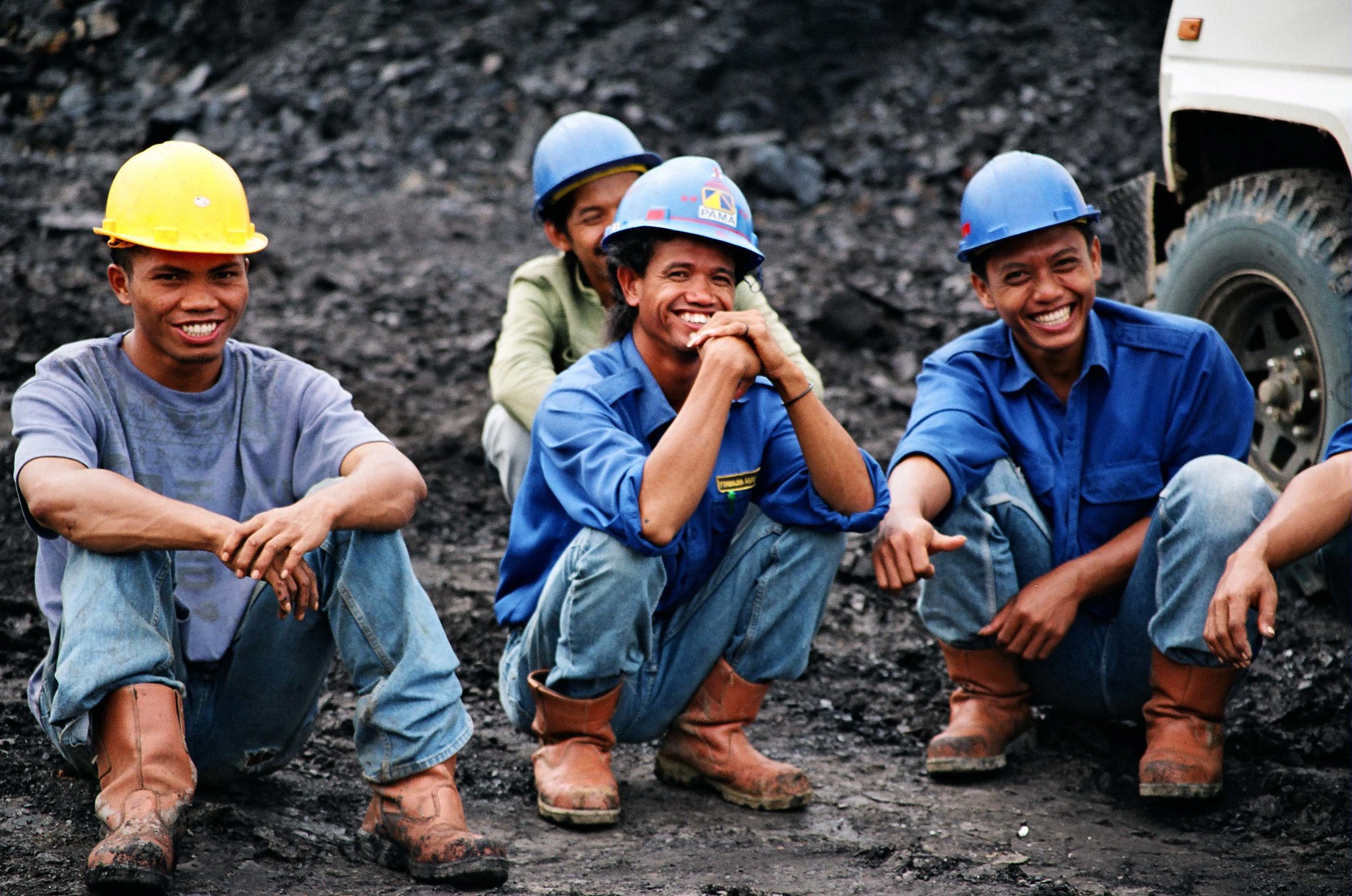
Coal miners in East Kalimantan, Indonesia. Credit: Cassidy K. / ILO / CC BY-NC-ND 2.0 DEED
Freedom of association and the right to collective bargaining are fundamental rights of labour unions, as enshrined in the 1998 International Labour Organization (ILO) Declaration on Fundamental Principles and Rights at Work. They are interrelated and inseparable: a trade union can’t exist without freedom of association, and its existence is meaningless if there’s no recognition of the right to collective bargaining—put simply, the ability of workers to negotiate jointly with employers on pay and conditions. Countries like Indonesia, which have ratified ILO Convention No. 87 (Freedom of Association) and ILO Convention No. 98 (the Right to Collective Bargaining), must make sure these rights are reflected in their legal systems. To do so, the Indonesian government has enacted laws on trade unions, stipulated in Law No. 21/2000, that protect these workers’ rights.
Under the IKI JET project, APHEDA has been supporting the Confederation of Indonesian Trade Unions (KSPI) and the Confederation of All Indonesian Trade Unions (KSBSI) to negotiate just transition clauses into collective bargaining agreements for their members in coal mining companies by raising awareness, training coal workers, and consulting their members about plans and proposals. This has prepared trade unions to advocate for coal workers’ rights and carry out collective bargaining for a fair and just transition at the company level by negotiating clauses that protect workers––for example, if the company is restructured or if workers are affected by severe climate events.
CBAs with just transition clauses in Indonesia
So far, with the support of the IKI JET project, Indonesian trade unions have successfully included just transition clauses in CBAs with five coal mining companies in East Kalimantan. All five CBAs have taken different forms, reflecting varying approaches to operationalising just transition.
One agreement between KSPSI and PT AECI Mining and Chemical Indonesia (PT AEL Indonesia) includes a clause that establishes a bipartite just transition committee (Lembaga Kerja Sama Bipartit or LKS Bipartit). This committee is intended to facilitate two-way communication between workers and the company, ensuring that the company makes decisions in consultation with workers. In practice, this means that the committee should function as a “forum for communication and consultation between the company and the labour union to develop industrial relations for the survival, growth, and development of the company, including employee welfare” as well as for “planning, supervising, and ensuring the implementation of a just transition for all workers.” Furthermore, the agreement stipulates that both the company and the trade union will send their representatives to the committee, that there will be regular meetings (every two months), and that the costs associated with the committee will be paid by PT AEL Indonesia.
In contrast to this governance-based approach, another agreement, reached between KSBSI and coal mining giant Kaltim Prima Coal (KPC), includes a clause that facilitates more operational just transition measures. Specifically, the clause sets out that “the company provides, supports, and facilitates employee training and development programmes to improve technical and non-technical knowledge and skills, […] and employees support these development and training programmes.”
How the agreements were reached
Initially, the companies argued that the transition was still a distant issue, pointing to Indonesia’s 2060 net-zero target, and that there was therefore no need to include such just transition elements in the CBAs. Ultimately, however, the unions were able to show that the energy transition will present challenges not only for coal workers but also for companies, which will eventually need to adapt and transform.
Though initiated by the trade unions, CBAs apply to all employees in a company. Therefore, it was important to hold meetings with union members and informally engage non-members to build broader support.
When it came to establishing a bipartite body through the agreements, like the just transition committee agreed in the CBA with PT AEL Indonesia, this was supported by the law. Indonesia’s Law No. 13/2003 on employment states that every company that employs 50 or more workers must establish a bipartite cooperation body to ensure two-way dialogue between employers and employees. The dedicated bipartite committee established through the CBA with PT AEL Indonesia is responsible for planning and monitoring the just transition at the company. It is funded by the company and will be renewed every two years as part of the regular process of ensuring that the CBA continues to be relevant as conditions change.
Broader goals ahead
The inclusion of just transition clauses in CBAs is an important milestone, but CBAs alone aren’t enough to provide comprehensive protection and support to all affected workers. Because CBAs apply at the company level, many workers and companies are outside the scope of the protections and support they provide.
Progress also varies significantly across different contexts. For instance, workers in larger mining companies have a stronger bargaining position when proposing CBAs on just transition, but those in smaller companies face a different reality. In these smaller companies, many workers are outsourced and employed under short-term contracts with limited job security, and their companies often serve as subcontractors for large companies that hold the mining permits. In such conditions, engaging in discussions on just transition is often not feasible. Structural barriers must also be addressed if the transition is to be truly inclusive; this is reflected in the underrepresentation of women and informal workers in the bipartite cooperation institution set up under the CBA with PT AEL.
Addressing these gaps requires action beyond individual agreements. Employer associations and trade unions should engage more systematically in just transition planning to ensure longer-term mutual benefits. At the same time, government bodies––such as the Manpower Agency––have a role to play in anticipating the risks of transition and requiring coal companies to provide just transition support through CBAs.
The implementation of CBAs is still constrained by several practical challenges. Many companies still view just transition as an additional burden rather than as part of their company’s broader sustainability and social responsibility strategies, which slows down the negotiation process for including just transition clauses. At the same time, trade unions often lack access to reliable data on the potential socio-economic impacts of the transition on workers––such as job losses, changing skills requirements, and employment shifts––which weakens their ability to negotiate effectively. Finally, limited technical capacity in some unions, especially in areas such as negotiation, legal drafting, and documentation, further limits progress.
Conclusion
The energy transition is not merely an environmental or technological issue; it is also an issue of workers’ rights, equity, and fairness. This means that only with inclusive participation, especially from impacted workers at every stage of change, can we ensure that the energy transition is truly just.
The experience of negotiating just transition clauses in CBAs in Indonesia has set a precedent by demonstrating that collective bargaining is important for embedding just transition considerations into company practices. This has resulted in trained union officials who understand the issue of just transition and its importance for workers’ rights, while also helping to educate employers about the issues.
As the examples show, these just transition clauses can take different forms––from governance structures that institutionalise dialogue to more operational measures, such as training and skills development.
At the same time, there are opportunities to build on existing company practices. Many coal companies already run pension preparation, training, and post-mining programmes; these could be more systematically aligned with just transition efforts, including by supporting the re-employment of affected workers.
As the coal phase-out gathers pace over the next decade, unions have done some important groundwork to better protect workers in the future. The experience with CBAs has also helped to position just transition as a core labour issue in Indonesia. This progress highlights the pioneering efforts of Indonesian trade unions on just transition, which could attract international interest and lead to the replication of such just transition clauses in Indonesia and beyond.
Related Posts
Stay Informed and Engaged
Subscribe to the Just Energy Transition in Coal Regions Knowledge Hub Newsletter
Receive updates on just energy transition news, insights, knowledge, and events directly in your inbox.