
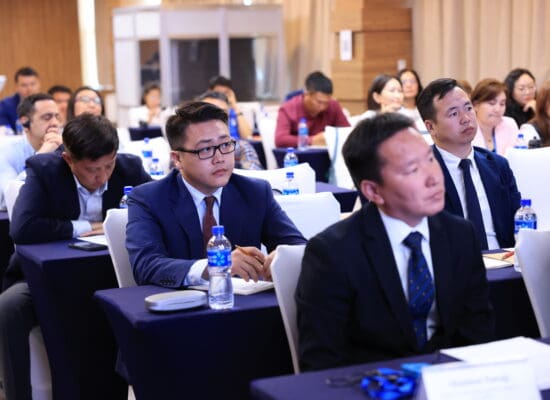
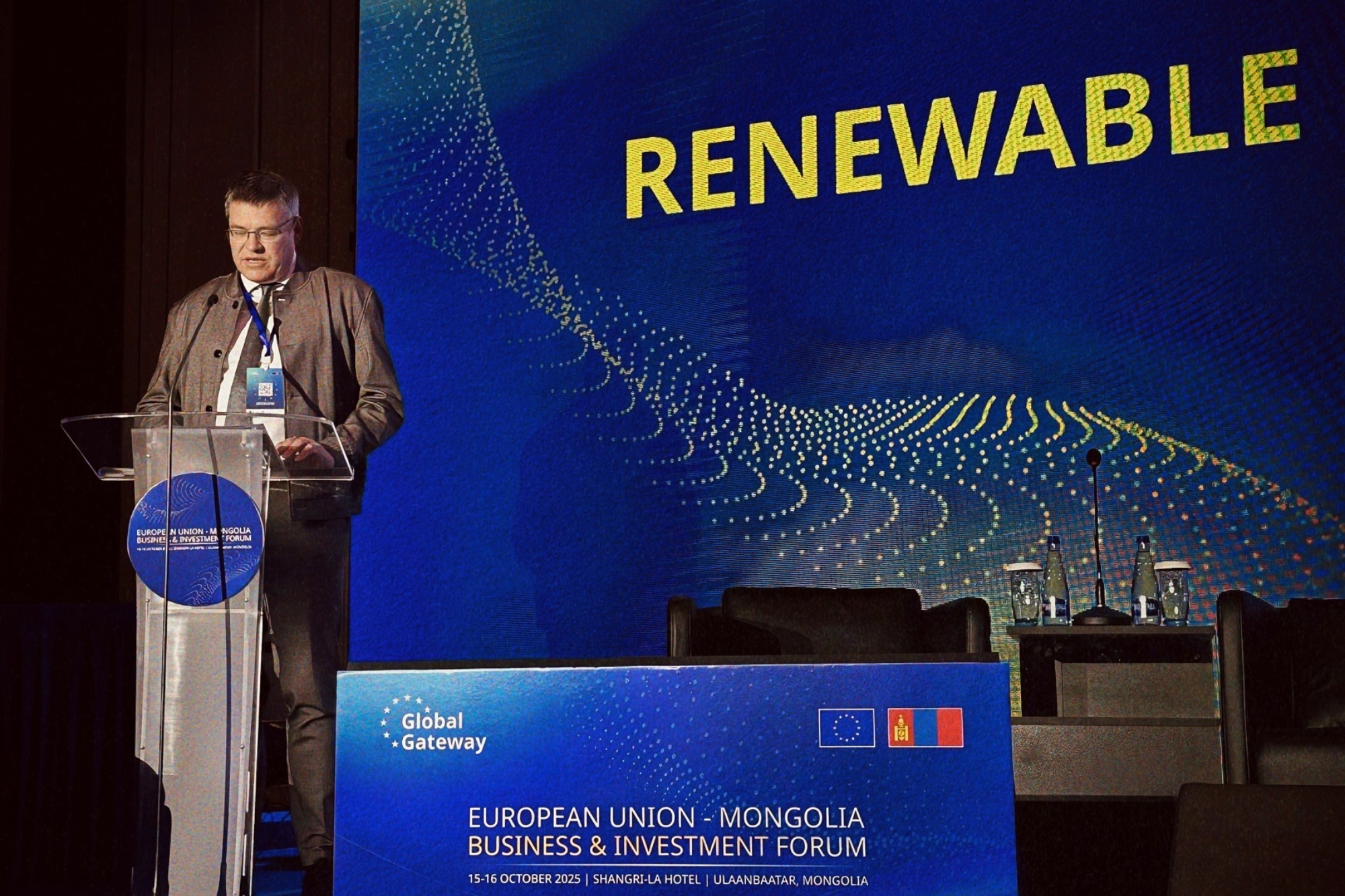
The inaugural EU–Mongolia Business & Investment Forum (15–16 October 2025) provided a platform for deepening the economic partnership between Mongolia and the European Union (EU), bringing together policy-makers, development partners, business leaders, and investors from both the two regions. A highlight of the Forum was the signing of a Memorandum of Understanding (MoU) by European Investment Bank (EIB) and the Government of Mongolia under the EU Global Gateway Initiative to unlock up to EUR 1 billion in investment for clean energy transition.
As part of the forum, the session entitled Renewable Energy and Green Technology was co-organised by the Deutsche Gesellschaft für Internationale Zusammenarbeit (GIZ) GmbH Mongolia. The session focused on the urgent need to decarbonise Mongolia’s energy and heating sector and to unlock opportunities for energy efficient and renewable heating solutions that can reduce emissions, air pollution, and long-term fiscal burdens. Specifically, heating is a priority not only for climate mitigation but also for public health, energy affordability, and social equity in Mongolia, with its long winters and severe air pollution. Advancing clean, efficient, and renewable heating solutions is therefore central to a just transition, ensuring that climate action delivers tangible social benefits, including improved public health, affordability, and more equitable living conditions.
Session Summary
In his welcome remarks, GIZ Mongolia representative Jürgen Hartwig emphasised the urgent need to advance renewable energy solutions, improve energy efficiency, and invest in clean heating technologies to ensure a sustainable and resilient future for Mongolia. He emphasised the strong partnership between the EU, the Government of Mongolia, and development partners in driving green growth, renewable energy development, and climate resilience.
During her keynote speech, Tsenguun Saruulsaikhan, Member of the State Great Khural (Parliament of Mongolia), presented an overview of Mongolia’s current heating and energy sector challenges. She mentioned data on air quality impacts, including reported cases of smoke inhalation and levels of particulate matter (PM) 2.5 that remain above international benchmarks despite significant public investment over the past 15 years. She underlined the importance of improving the effectiveness and transparency of public spending and advancing ongoing energy sector reforms. These reforms include tariff adjustments, early steps towards market liberalisation, strengthened state-owned enterprise (SOE) governance, and updated legal frameworks to encourage greater competition and participation from new stakeholders. Maintaining momentum in reform, she noted, is essential to attracting private investment and enabling long-term modernisation of systems. In this context, heating sector reform was framed not only as an emissions reduction challenge but also as a means to reduce avoidable health burdens, household medical costs, and unequal exposure to pollution—all critical for sustaining public trust in the transition process.
Peteris Ustubs, Director for Asia and the Pacific at the European Commission, highlighted that the MoU signed between the Government of Mongolia and the EIB comes at a crucial time, given that renewable energy presents a vast opportunity in Mongolia. He stated that the EU is firmly committed to supporting Mongolia in advancing its renewable energy sector through technical cooperation, financial assistance, and comprehensive partnership across all relevant areas.
Jason Lee, Deputy Regional Director at the Global Green Growth Institute (GGGI), presented findings from the Sainshand Solar District Heating feasibility study, which assessed hybrid systems combining solar thermal collectors, thermal storage, and existing coal-fired boilers. The study indicates that solar thermal could supply approximately 20% to 24% of annual heat demand, reducing coal consumption and operating costs. Favourable renewable resources and existing district heating infrastructure make Sainshand a suitable pilot city, with similar potential identified in Khovd, Arvaikheer, and Mandalgovi. GGGI also introduced a USD 27 million blended finance mechanism to support scale-up across provinces. Beyond technical benefits, district heating modernisation was highlighted as a way to improve reliability during extreme winters, stabilise heat tariffs over time, and extend the social and environmental benefits of the energy transition beyond Ulaanbaatar.
Asdin Hassen, Head of Projects New Markets at Enertrag, outlined a technical concept for integrating large-scale renewable electricity generation with heating through a combined power plant architecture, which blends wind, solar PV, battery storage, and electrode boilers to deliver flexible heat and power supply. Enertrag’s resource assessments indicate that areas within 60 km of Ulaanbaatar hold substantial wind and solar potential suitable for multi-megawatt development. According to their modelling, renewable electricity can be efficiently converted into heat and integrated into existing district heating networks using drop-in technologies, which offers cost-competitive performance compared with new thermal generation. He emphasised that successful deployment depends on clear offtake arrangements, alignment with national planning, access to blended finance, and capacity building. Power-to-heat solutions were also highlighted as a means to enhance system flexibility, reduce renewable curtailment, and ensure reliable heat supply during peak winter demand, supporting energy security.
Sodbileg Lodoisambuu from Nemu Energy presented a practical heat-storage solution through a sand-battery demonstration project in Ulaanbaatar, illustrating how high-temperature thermal storage can be applied to smaller-scale or building-level heating needs. The pilot aims to test operational performance in the Mongolian climate and contribute to a wider range of technological options available for clean heating.
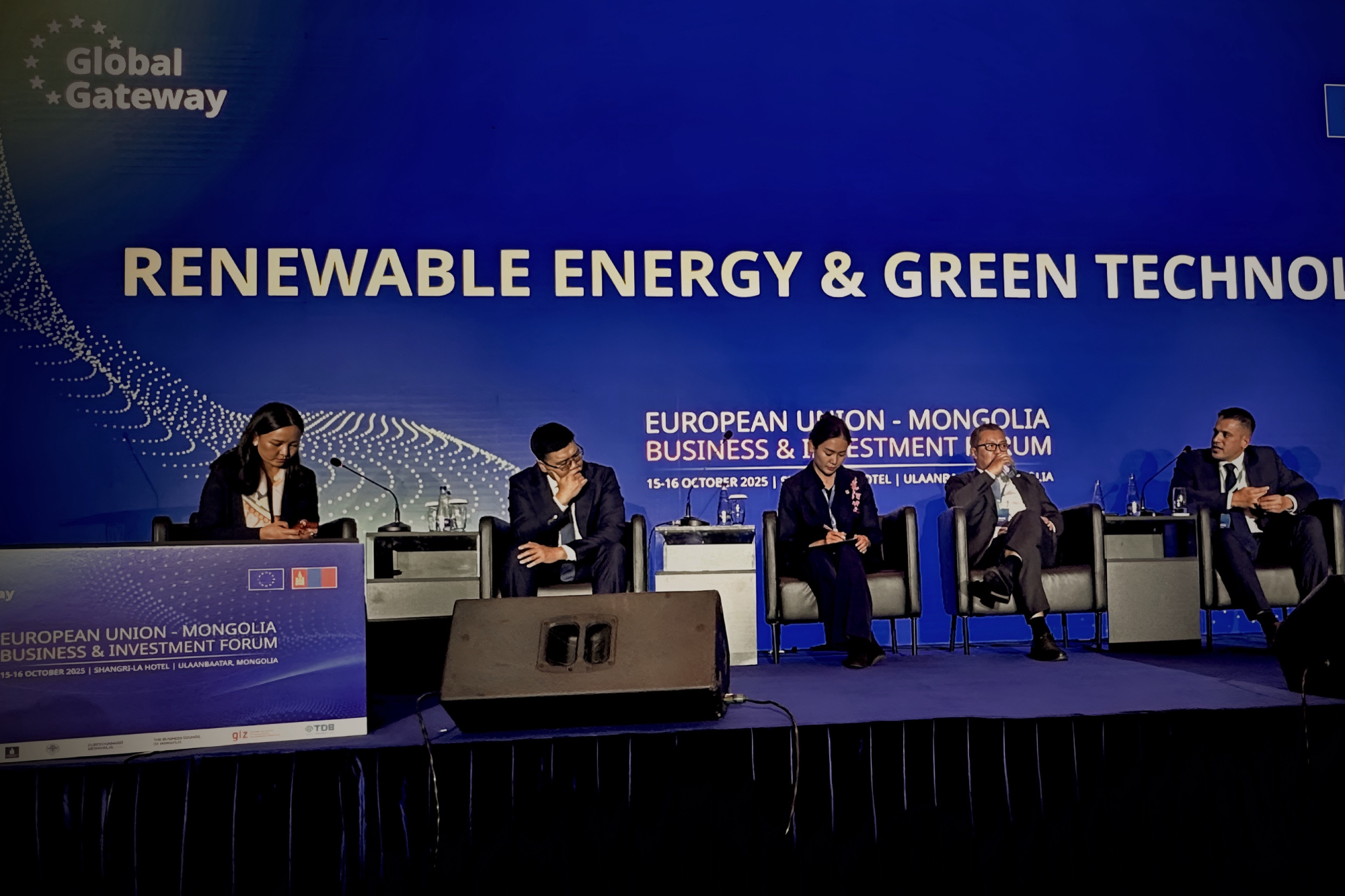
The panel discussion involved the State Secretary of the Ministry of Energy, Yeren-Ulzii Batmunkh, two members of parliament (Tsenguun Saruulsaikhan and Zoljargal Jargalsaikhan), two private sector representatives (Sodbileg Lodoisambuu from Nemu Energy and Hassen from Enertrag), and Jason Lee from GGGI. The panel discussed the main opportunities and challenges, agreeing that improving the legal and policy framework is now more crucial than ever in order to make the Mongolian market more attractive to private investors. At the same time, speakers highlighted the importance of aligning market reforms with social considerations to ensure that the transformation of the heating sector delivers equitable outcomes, safeguards affordability, and ensures universal access to clean, safe, and reliable heat. Nevertheless, the overall message was positive, with a clear sense of what actions are required from the Government of Mongolia—including amending or developing the supporting legal framework, and fostering a stable and favourable investment environment.
Key takeaways
- Modernising Mongolia’s heating sector is critical to achieving the country’s climate and energy transition goals.
- Renewable-based district heating solutions can significantly cut carbon dioxide (CO₂) emissions and improve air quality.
- Collaboration under the EU’s Global Gateway offers new financing and technical cooperation opportunities.
- Policy and regulatory reforms are essential for enabling private sector investment and project bankability.
- The EIB’s planned engagement signals strong EU commitment to Mongolia’s clean energy transition.
- European technology providers and investors can play a key role in supporting Mongolia’s sustainable energy transformation.
Speakers
- Asdin Hassen, Head of Projects New Markets, Enertrag
- Jason Lee, Deputy Regional Director, Global Green Growth Institute (GGGI)
- Jürgen Hartwig, Resident Representative, GIZ Mongolia
- Peteris Ustubs, Director of Asia and the Pacific, European Commission
- Sodbileg Lodoisambuu, CEO, Nemu Energy
- Tsenguun Saruulsaikhan, Member of Parliament
- Yeren-Ulzii Batmunkh, State Secretary, Ministry of Energy
- Zoljargal Jargalsaikhan, Member of Parliament
The session was moderated by Khulan Bat-Erdene, Advisor to the Minister, Chartered Financial Analyst, Ministry of Economic Development
Related Posts

Stay Informed and Engaged
Subscribe to the Just Energy Transition in Coal Regions Knowledge Hub Newsletter
Receive updates on just energy transition news, insights, knowledge, and events directly in your inbox.