
Report
Intersecting Inequalities and the Limits of Post-Mining Transition in East Kalimantan
This report examines the livelihoods, resource access, and intersecting inequalities for women and marginalised groups, through a case study of Kerta Buana, a transmigrant village in Tenggarong Seberang sub-district, Kutai Kartanegara regency, East Kalimantan, as local communities perceive and experience coal mine closure as a sudden rupture to the local economy.
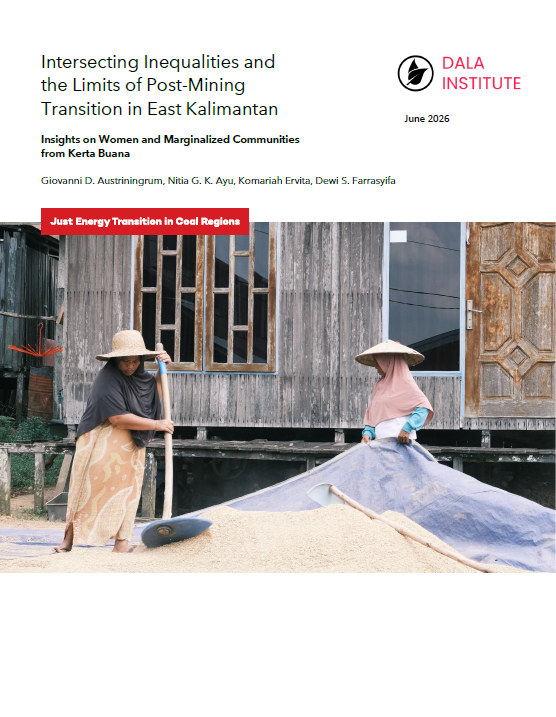
East Kalimantan is Indonesia’s largest coal-producing region. Kerta Buana village was established in 1980 as a transmigrant settlement and developed a thriving agricultural economy. By the mid-2000s, large-scale open-pit mining had displaced 70–80% of its agricultural land, destroyed its primary water sources, and restructured its entire social and economic life around coal. In February 2022, a major mining company operating in the area formally ceased operations, initiating what is officially framed as a post-mining recovery phase.
Among coal-affected communities in East Kalimantan, Kerta Buana stands out as a particularly legible site for examining what post-mining transition actually looks like on the ground: it combines sudden corporate closure, a diverse community composition (including transmigrant groups and women in the informal sector) and the layered, intersecting inequalities that shape who bears transition costs.
The analysis draws on four theoretical traditions: feminist political economy, feminist political ecology, intersectionality, and decolonial and postcolonial scholarship, organised around four interrelated dimensions of justice: redistribution, recognition, representation, and reparation. These are used as an analytical device to discuss the findings, not a claim to exhaust what justice requires.
Related Posts
Stay Informed and Engaged
Subscribe to the Just Energy Transition in Coal Regions Knowledge Hub Newsletter
Receive updates on just energy transition news, insights, knowledge, and events directly in your inbox.