

Report
5 Principles for the Democratisation of the Just Energy Transition in Colombia
The case of Cesar and Magdalena
This report examines early implementation of Colombia’s just energy transition policies in coal and mining territories, where major regulatory and governance gaps are emerging.
Focusing on Cesar and Magdalena, it shows how current national instruments lack a differentiated approach for mine closure, decarbonisation, and territorial realities.
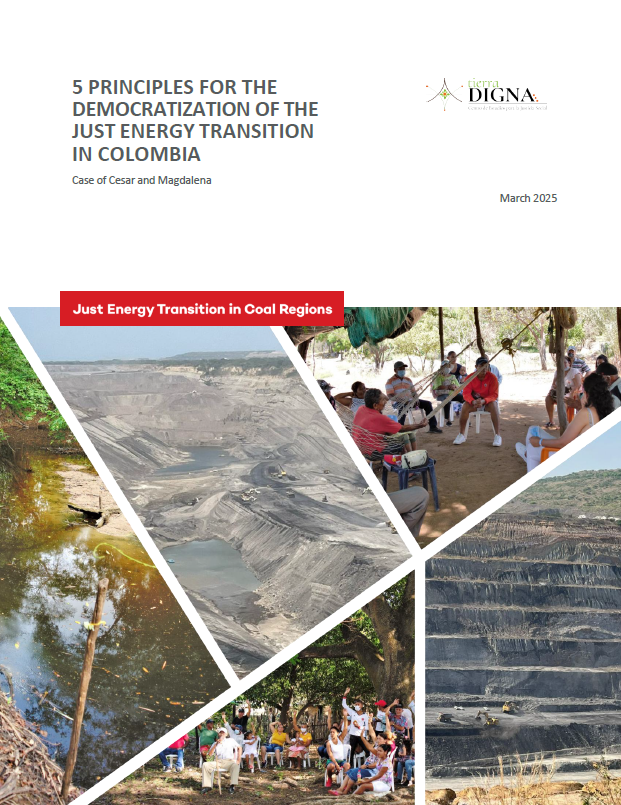
It argues that democratising just energy transition (JET) policy is essential to ensure legitimacy and results, and emphasises the importance of participation, prior consultation, transparency, and access to information.
The report assesses the scope, limitations, and obstacles of emerging energy transition policies in mining areas, focusing on Cesar and Magdalena. It finds that Colombia’s public policy framework does not yet incorporate a differential approach for mining territories—particularly regarding mine closure and decarbonisation—creating a critical regulatory gap that slows progress and fuels conflict.
The report proposes democratisation as a practical governance pathway to improve policy control, effectiveness, and legitimacy, anchored in basic rights: effective participation, prior consultation, transparency, and access to information.
It then develops the foundation for durable agreements among stakeholders through five principles: prioritising economic transition in mining regions; ensuring transparency throughout; creating binding dialogue mechanisms from local to national levels; guaranteeing accessible information for all actors; and providing special support for vulnerable groups, including women, farmers, trade unions, and Indigenous peoples. Recommendations outline concrete policy mechanisms for implementation.
Related Posts
Stay Informed and Engaged
Subscribe to the Just Energy Transition in Coal Regions Knowledge Hub Newsletter
Receive updates on just energy transition news, insights, knowledge, and events directly in your inbox.