
Commentary
Just Transition in Spain: Phasing out fossil fuel and enabling renewables deployment
Country:
Spain,
Organisation:
Elcano Royal Institute,

Spain’s just transition governance framework is among the most advanced in the world, alongside those in the likes of France and Colombia. Despite some challenges that remain, Spain’s experience could inspire other countries to develop their own locally adapted just transition frameworks.
Anchoring just transition in law, policy, and society
Spain adopted its Strategic Energy and Climate Framework in 2019 to meet its European and international climate commitments under the Paris Agreement. This framework included the development of a just transition strategy (JTS). Upholding Spain’s climate commitments means that a profound restructuring of the country’s socio-economic fabric is needed at a time when public opinion among Spanish citizens is evenly split on whether the economic impact of the net-zero transition is positive or negative. In a 2023 survey carried out by the Elcano Royal Institute 24% of respondents stated their belief that climate action reduces their personal freedom.
More encouragingly, however, 70% of survey respondents supported government investment in areas that could suffer business losses due to the impacts of climate change or the policies implemented to address it. Just transition policies enjoyed greater consensus among those who completed the survey, with support from across the ideological spectrum. In short, the survey shows that citizen support for just transition is high in Spain, and this could assuage concerns about, and opposition to, the country’s decarbonisation goals.
To address the socio-economic impacts of the transition, Spain has developed an innovative just transition governance framework under Title VI of the Climate Change and Energy Transition Law (Law 7/2021) and measure 1.25 of the National Energy and Climate Plan 2023–2030. The climate law mandates the development of a JTS every 5 years, with the second JTS expected by 2026. It also makes just transition agreements (JTAs) a requirement as a key co-governance project-based tool to help drive economic development, diversification, and specialisation while limiting depopulation in areas where a just transition is taking place. Spain has further institutionalised just transition by creating the Just Transition Institute (JTI), which has a dedicated team focused on implementing the JTS.
The goals of Spain’s first JTS include providing (green) economic opportunities to regions in transition, restoring the degraded environment, and supporting communities affected by the coal phase-out while ensuring that employment levels don’t decline in these regions. The funding for Spain’s just transition is summarised in the following table.
Table 1. Funding the just transition in Spain
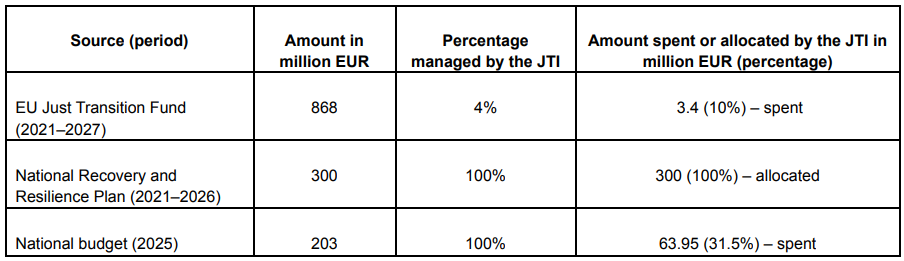
Source: Just Transition Institute (2025)
With the implementation of the JTS, Spain’s government hopes to mobilise EUR 7 billion in private investment in industrial and energy-related projects. To implement an urgent action plan to manage the coal phase-out, tripartite agreements have been signed between the government, trade unions, and businesses. Protocols to develop JTAs are being signed between national, regional, and local government, with stakeholders being consulted to ensure that JTA-related projects are tailored to the local context and resources, strengthening shared ownership of the transition. The JTI deploys numerous instruments to support the development of JTAs (there are currently 15 JTAs—co-governance tools engaging national, regional, and local stakeholders to develop economic opportunities, covering 197 municipalities in 8 regions) and the tripartite agreements. These instruments include, among others, calls for business support schemes; municipal projects; training and education programmes; environmental restoration projects; and just transition tenders (which prioritise local benefits and environmental safeguards when awarding grid access to renewables and storage projects in former coal regions).
The JTI expects the JTS to deliver a number of jobs similar to the number that will be lost due to the closure of coal mines and coal power plants. Even before the European Union’s Just Transition Fund was available, all workers who requested upskilling or reskilling from the JTI received it. So far, support has been given to 279 local business projects, estimated to generate 1,200 jobs. Best practice examples, such as that of an Andorra thermal plant, have resulted in just transition tenders where 1,300 people will receive training and 3,800 people are expected to benefit from producing and consuming their own power (self-consumption). Additionally, 200 municipal projects, worth EUR 203 million, have been approved to support entrepreneurship, health, tourism, social housing, infrastructure, and more. A programme designed to promote cultural activities and local artists, attract people to regions in transition, and promote a sense of belonging (Dinamiz-ARTj), has received 1,400 applications from young artists to perform in 136 municipalities.
Looking ahead: broadening the scope of the transition
The forthcoming JTS (2026–2030) is expected to continue addressing the fossil fuel and nuclear phase-out under a governance framework similar to the one used for the coal phase-out. The scope of the strategy is also expected to be broadened, potentially issuing sectoral guidance for a just transition (rather than developing JTAs) in areas such as transport, construction, or industry.
Given Spain’s ambitious updated climate goal of reducing emissions by 32% by 2030 (compared with 1990 levels), just transition is set to become increasingly important when it comes to ensuring that climate policies are socially acceptable. Based on the analysis of Spain’s just transition framework and on stakeholder recommendations collated by the Ministry for Ecological Transition and the Demographic Challenge during a series of stakeholder consultation workshops, the following policy recommendations could be included in the upcoming JTS (and its potential expansion into renewables deployment):
1. Continue providing support to limit the impact of the fossil fuel phase-out while expanding the reach of the JTS to those sectors that are affected by decarbonisation policies and are increasingly vulnerable to the impacts of climate change.
2. Strengthen public participation and governance through early and sustained citizen and stakeholder engagement.
3. Promote local empowerment and socio-economic integration by investing in community-driven and prosumer promotion initiatives that support vulnerable groups, foster economic diversification based on local resources, provide job opportunities, and strengthen the skills of local authorities and communities.
4. Advance gender equity by scaling training programmes for women in traditionally male-dominated sectors, while fostering women-led entrepreneurship in rural areas.
5. Support rural development by integrating renewables deployment in rural development plans to counter depopulation and stimulate economic growth.
6. Ensure transparency through robust mechanisms that monitor and evaluate the social, economic, and environmental impacts of renewables initiatives.
7. Strengthen multi-level governance and international collaboration to share best practices and build a robust global just transition approach, framework or mechanism that can be adapted to local circumstances and needs.
8. Broaden the concept of just transition to include a just and socially acceptable deployment of renewables, the buildout of low-carbon technologies and infrastructures, and the development of just resilience frameworks.
Building on Spain’s JTS by developing Just Renewables Transition Agreements
Spain’s updated NECP sets an ambitious goal of reaching 160 GW of installed renewables capacity by 2030. However, renewables deployment has sparked growing resistance in some regions, highlighting the need for new governance tools to accompany the renewables phase-in process. To address this, just renewables transition agreements (JRTAs)—mirroring JTAs but designed for the phase-in of renewables and for the uptake of other technologies and infrastructures needed to reach climate neutrality—could be an effective tool. JRTAs could provide an institutionalised, structured, transparent and flexible governance framework for the private sector, communities, and governments to co-design locally adapted and resilient renewables projects that are supported by citizens and stakeholders alike.
To enhance citizens’ acceptance of renewable energy systems and smooth any socio-economic friction that arises in their development, there are (private) programmes for the deployment of renewables projects, expert input, civil society initiatives, and tools (such as EUDEMON) for resolving socio-ecological conflict. However, Spain’s just transition currently lacks an institutionalised governance framework that ensures both social acceptability of renewables deployment and a structured engagement process. This lack is limiting the requirement for stakeholders to use JTAs in renewables deployment projects (a process that defines, among other things, what kind of compensation projects municipalities can demand so that the financial viability of the renewables project is not endangered).
Conclusion
Spain’s just transition governance framework, which until now has focused mainly on coal phase-out, presents an innovative approach that has delivered concrete results and garnered significant support from Spanish citizens. Key innovations include the development of the JTI to implement the JTS and JTAs—a co-governance approach to addressing the impacts of Spain’s energy transition.
Achieving Spain’s current energy and climate goals requires phasing out nuclear power plants, decarbonising additional economic sectors, and deploying a significant amount of renewables. The existing just transition framework can be expanded to cover nuclear phase-out, and changes can be made to ensure that guidance is given to other sectors in transition (e.g. transport). Broadening the existing governance framework to enhance the political and social acceptability of Spain’s energy transition is also a promising opportunity.
Building on the experience of JTAs, just renewables transition agreements are being proposed as an additional governance tool that could help structure a multilevel dialogue between the government, regional authorities, local authorities, companies, and citizens to deliver Spain’s renewables goals, while enhancing social acceptance of renewables deployment and fostering the economic viability of investments.
The authors gratefully acknowledge the comments made by Jonas Kuehl (International Institute for Sustainable Development), María Peñahora (JTI), and Julián Martínez (JTI). All errors and omissions remain the sole responsibility of the authors.
Related Posts

Stay Informed and Engaged
Subscribe to the Just Energy Transition in Coal Regions Knowledge Hub Newsletter
Receive updates on just energy transition news, insights, knowledge, and events directly in your inbox.